
Introduction
Mehndi is an integral part of Indian weddings, festivals, and celebrations. But when it comes to choosing the perfect design, brides often find themselves confused between Arabic mehndi and Indian mehndi. Both styles are breathtakingly beautiful, yet they are fundamentally different in design, application, and symbolism.
If you’re planning your wedding or attending a family function, understanding Arabic vs Indian mehndi is crucial to picking the right style for your outfit, event, and personal preference.
In this comprehensive guide, we’ll walk you through 7 key differences between Arabic and Indian mehndi, their pros and cons, and help you decide which one is perfect for you.
👉 Need expert guidance for your big day? Book a session with our professional bridal mehndi service to get flawless designs.
What is Arabic Mehndi?
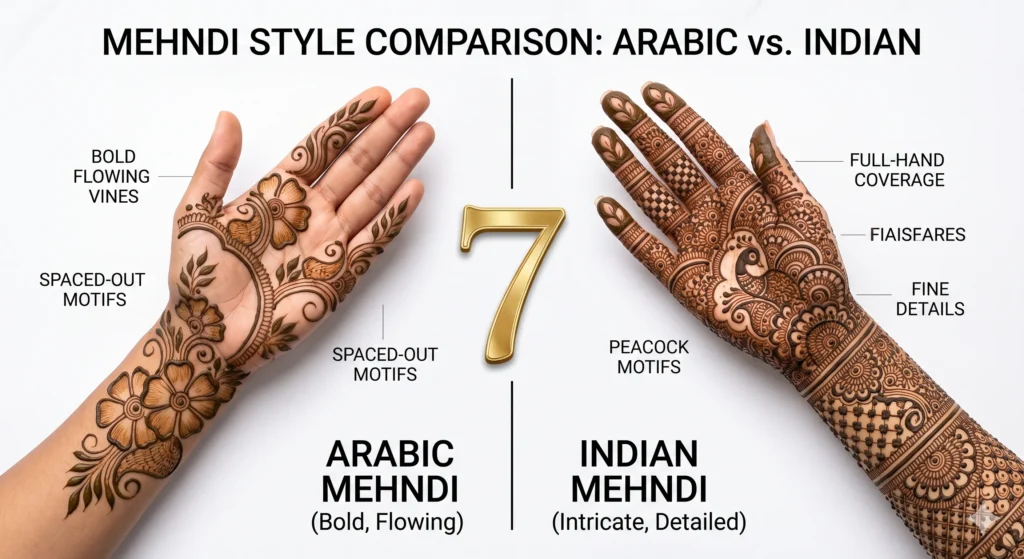
Arabic mehndi originated in the Middle Eastern countries and is known for its bold, flowing, and spacious designs. Unlike Indian mehndi, Arabic designs do not cover the entire hand or foot. Instead, they feature large, prominent floral motifs, vines, and leaves with plenty of empty space between the patterns.
Key Characteristics:
- Large floral patterns
- Flowing vines and leaves
- Spaced-out motifs
- Less intricate, more prominent
- Often leaves fingers and palms partially empty
What is Indian Mehndi?
Indian mehndi, also known as Rajasthani or Marwari mehndi, is the traditional style used in Indian weddings. It is characterized by intricate, dense, and detailed patterns that cover the entire hand, palm, and fingers. Indian mehndi often includes symbolic elements like peacocks, elephants, paisleys, and bridal figures.
Key Characteristics:
- Full-hand coverage
- Intricate fine lines and details
- Symbolic motifs (peacocks, paisleys, mandalas)
- Dense patterns with minimal empty space
- Often includes the bride’s name or groom’s name hidden in the design
7 Key Differences Between Arabic and Indian Mehndi
Here are the 7 major differences that set these two beautiful mehndi styles apart:
1. Design Density & Coverage
| Aspect | Arabic Mehndi | Indian Mehndi |
| Coverage | Partial – leaves gaps | Full – covers entire hand/foot |
| Density | Light and airy | Dense and intricate |
| Visual Feel | Bold and prominent | Rich and traditional |
Arabic mehndi uses larger motifs with significant gaps between them, giving a bold and modern look. Indian mehndi, on the other hand, fills every inch of the skin with intricate patterns, creating a traditional, royal, and bridal appearance.
2. Motifs & Symbols
Arabic mehndi primarily features:
- Large flowers
- Leaves and vines
- Abstract geometric shapes
- Minimal human or animal figures
Indian mehndi is rich with cultural symbolism:
- Peacocks (symbol of beauty)
- Elephants (symbol of strength and royalty)
- Paisleys (symbol of fertility)
- Bridal figures and wedding scenes
- Hidden names of the bride and groom
3. Application Technique
Arabic mehndi is applied using heavy, thick cones that create bold lines and large motifs. The artist moves quickly, focusing on prominent shapes rather than fine detailing.
Indian mehndi requires thin, delicate cones and steady hands. The artist spends hours creating fine lines, dots, and intricate patterns. It requires immense patience and skill.
👉 For your wedding, trust experienced artists who specialize in both styles. Check out our engagement mehndi artists for flawless application.
4. Time Required
| Style | Time Required |
| Arabic Mehndi | 1 – 2 hours |
| Indian Mehndi | 3 – 6 hours |
Arabic mehndi is quicker to apply because of the larger motifs and less coverage. Indian mehndi takes much longer due to the detailed and dense patterns. Brides often sit for 4-5 hours for a full traditional bridal mehndi.
5. Occasion & Suitability
Arabic mehndi is perfect for:
- Engagement ceremonies
- Sangeet nights
- Party or festive events
- Modern, minimalist brides
- Brides who want quick application
Indian mehndi is ideal for:
- Traditional weddings
- Brides who want a royal, heavy look
- Full-day wedding rituals
- Brides who want to hide their groom’s name
6. Stain Color & Aftercare
The stain color depends more on the henna quality and aftercare than the style itself. However:
- Indian mehndi tends to look darker because of the dense coverage – more dye is absorbed by the skin.
- Arabic mehndi with its spaced-out designs may look lighter in comparison, but proper aftercare can make it equally dark.
For both styles, following proper aftercare is essential. Read our guide on mehndi aftercare tips for long-lasting stain to ensure deep, dark color.
7. Cost & Pricing
| Style | Cost |
| Arabic Mehndi | Lower – less time and coverage |
| Indian Mehndi | Higher – more time and intricate work |
Indian bridal mehndi costs more because of the time, skill, and detail involved. Arabic mehndi is more budget-friendly while still looking elegant.
Which One Should You Choose?
The decision between Arabic vs Indian mehndi depends on:
| Factor | Choose Arabic Mehndi | Choose Indian Mehndi |
| Wedding Theme | Modern, minimalist | Traditional, royal |
| Time Available | 1-2 hours | 4-6 hours |
| Budget | Budget-friendly | Premium pricing |
| Personal Style | Bold, spacious | Dense, intricate |
| Outfit Type | Contemporary lehenga | Heavy bridal lehenga |
FAQs: Arabic vs Indian Mehndi
Q1: Which mehndi is better – Arabic or Indian?
Neither is “better” – it depends on your personal style, wedding theme, time, and budget. Arabic is modern and bold, while Indian is traditional and intricate.
Q2: Can I combine both styles?
Absolutely! Many artists now create Indo-Arabic mehndi – a fusion of both styles. For this, you can explore premium mehndi services across India that specialize in fusion designs.
Q3: Which mehndi gives darker color?
Both can give dark color with good quality henna and proper aftercare. However, Indian mehndi often appears darker due to dense coverage.
Q4: Which mehndi is faster to apply?
Arabic mehndi is faster (1-2 hours) compared to Indian mehndi (3-6 hours).
Q5: Which style is more expensive?
Indian mehndi is more expensive because of the time and detail involved.
Conclusion
Both Arabic mehndi and Indian mehndi are stunning in their own ways. The choice ultimately depends on your wedding theme, personal preference, time, and budget.
If you want a bold, modern, and quick design, go for Arabic mehndi. If you want a traditional, intricate, and royal look, Indian mehndi is the way to go. And if you can’t decide, many artists now offer Indo-Arabic fusion designs that give you the best of both worlds!
No matter which style you choose, always use 100% natural henna and follow proper aftercare to get the darkest, longest-lasting stain.
👉 Ready to book your dream mehndi? Explore our bridal mehndi packages for Arabic, Indian, or fusion styles.